
TODAY’S WORD | from Hiragana Times “News Review”
過去最多
ka · ko · sa · i · ta
Say it in 5 beats: ka-ko-sa-i-ta
過去 kako = the past + 最多 saita = the most (in number)
“a record number” — more than ever before
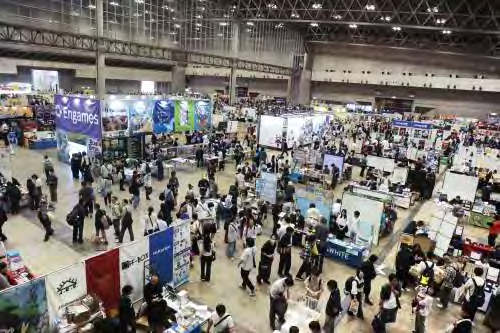
On October 17 and 18, “Game Market 2026 Autumn,” a festival of analog games, was held at Makuhari Messe. The number of exhibitors? Higher than ever. Japanese news has one compact word for that: 過去最多 (kako saita), “the most in all the past.”
In English, you simply say a record: “a record 1,425 booths.” You hear 過去最多 on Japanese news almost every day. Learn it here, and the news starts to sound familiar.
Read and say 過去最多 in 5 even beats, read a big number like 1,425 in Japanese, recognize three phrases you often hear on Japanese news, and describe an event in two Japanese sentences. Allow about 15–20 minutes.
How to read the Japanese on this page: small hiragana under each kanji show how to read it. Under each Japanese line you’ll find romaji (gray) and English.
Read & Say | 過去最多, sound by sound
過去最多 is written with 4 kanji, but it has 5 beats. In Japanese, each beat takes the same length of time.
- Four kanji, five beats: 過 = ka, 去 = ko, 最 = sai (2 beats), 多 = ta. Count “ka-ko-sa-i-ta” on five fingers.
- さい (sai) is two beats, not one: it sounds close to English “sigh,” but give a and i one full beat each: sa-i.
- Keep it flat and even: English speakers tend to stress one syllable, like “KAH-ko-SAI-ta.” In Japanese, no beat is pushed harder or held longer. Keep every vowel short and clear: ko, not “koh-oo”; ta, not “tuh.”
A kako saita moment in your life?
Think first: Have you ever been to an event with more people than ever before? And what board game or card game do you play with family or friends? A note in any language is fine.
Read & Listen | kako saita in Hiragana Times
Here is the News Review article “ゲームの原点は、今も生きている” (The Origin of Games Is Still Alive), where 過去最多 appears. Read the English first, then try the Japanese.
On October 17 and 18, “Game Market 2026 Autumn,” a festival of analog games, was held at Makuhari Messe.
10月17日と18日、幕張メッセで、アナログゲームの祭典「ゲームマーケット2026秋」が開かれました。
Jūgatsu jūshichinichi to jūhachinichi, Makuhari Messe de, anarogu gēmu no saiten “Gēmu Māketto nisen nijūroku aki” ga hirakaremashita.
Exhibitors reached a record 1,425 booths. New board games and card games fill the whole venue.
出展は過去最多の1,425ブース。ボードゲームやカードゲームの新作が、会場いっぱいに並びます。
Shutten wa kako saita no sen yonhyaku nijūgo būsu. Bōdo gēmu ya kādo gēmu no shinsaku ga, kaijō ippai ni narabimasu.
In Germany, the home of board games, companies take the lead, but in Japan, individuals who make their own games play the leading role.
本場ドイツでは企業が中心ですが、日本では自作の個人が主役です。
Honba Doitsu de wa kigyō ga chūshin desu ga, Nihon de wa jisaku no kojin ga shuyaku desu.
In analog games, there is no hidden program.
アナログゲームに、隠されたプログラムはありません。
Anarogu gēmu ni, kakusareta puroguramu wa arimasen.
The rules are the program, and the players can freely arrange them.
ルールがプログラムで、遊ぶ人が自由にアレンジできます。
Rūru ga puroguramu de, asobu hito ga jiyū ni arenji dekimasu.
That is why fans treasure the rules, and at the venue everyone takes their turn and laughs together.
だからこそファンはルールを大切にし、会場では誰もが順番を守り、笑い合っています。
Dakara koso fan wa rūru o taisetsu ni shi, kaijō de wa dare mo ga junban o mamori, waraiatte imasu.
Turning keeping the rules into a pleasure.
ルールを守ることを楽しみに変える。
Rūru o mamoru koto o tanoshimi ni kaeru.
Germany and Japan may share such a trait.
ドイツと日本に、そんな共通点があるのかもしれません。
Doitsu to Nihon ni, sonna kyōtsūten ga aru no kamo shiremasen.
Listening point: The audio has English and Japanese. In the Japanese, listen for 過去最多 (kako saita) and 順番 (junban, “turn, order”).
The example sentences, conversation and quiz below were written by We Languages for learning. They are not quotes from the article.
Using kako saita | 過去最多の + number
過去最多 is built like a small puzzle: 過去 (kako, the past) + 最多 (saita, the largest number). Word for word, “the most in all the past” — in other words, a record. Put it before a number with の (no): 過去最多の + number = “a record + number.”
出展は過去最多の1,425ブース。
Shutten wa kako saita no sen yonhyaku nijūgo būsu.
Exhibitors reached a record 1,425 booths. (Hiragana Times)
今年の参加者は過去最多です。
Kotoshi no sankasha wa kako saita desu.
This year saw a record number of participants.
Read the number | 1,425 and the date
1,425 is read せん よんひゃく にじゅうご (sen yonhyaku nijūgo). Note that 400 is always よんひゃく (yonhyaku), never しひゃく (shihyaku). For the date, 10月17日 is read じゅうがつ じゅうしちにち (jūgatsu jūshichinichi), and 18日 is じゅうはちにち (jūhachinichi).
Most vs. highest | kako saita and kako saikō
最多 is for a count — people, booths, cases. For a level that goes up, like temperature or sales, Japanese uses 過去最高 (kako saikō). In English, both often become “a record.”
気温は過去最高でした。
Kion wa kako saikō deshita.
The temperature was a record high.
News Japanese around kako saita
Around 過去最多, the article uses phrases you hear on Japanese news all the time:
- 〜が開かれました (… ga hirakaremashita): “… was held.” It is the passive form of 開く (hiraku, to open, to hold). Just like English “was held,” it doesn’t say who organized it — the event is the subject.
- 出展 (shutten): exhibiting at a fair. A person or company that exhibits is a 出展者 (shuttensha, exhibitor).
- AではXが中心ですが、BではYが主役です: “In A, X takes the lead, but in B, Y plays the leading role.” 〜ですが (desu ga) shows contrast, like “but.”
- 順番を守る (junban o mamoru): word for word “to protect the order” — that is, to take your turn. In the same way, ルールを守る (rūru o mamoru) = to keep the rules.
みんな順番を守って遊びます。
Minna junban o mamotte asobimasu.
Everyone takes turns and plays.
Key Words | Words to talk about kako saita
| Japanese | Romaji | English |
|---|---|---|
| 過去最多 | kako saita | a record (number) |
| 出展 | shutten | exhibiting (at a fair) |
| 祭典 | saiten | festival |
| 会場 | kaijō | venue |
| 新作 | shinsaku | new work, new release |
| 本場 | honba | home (of something) |
| 主役 | shuyaku | leading role |
| 順番を守る | junban o mamoru | to take one’s turn |
| 共通点 | kyōtsūten | something in common |
Mini Dialogue | Use kako saita in a conversation
Two friends visit a board game fair. This is casual Japanese between friends.
A:すごい人だね。
Sugoi hito da ne.
Wow, it’s so crowded.
B:うん、出展も過去最多なんだって。
Un, shutten mo kako saita nan datte.
Yeah, I heard there’s a record number of exhibitors, too.
A:このゲーム、やってみたい!
Kono gēmu, yatte mitai!
I want to try this game!
B:じゃあ、順番を守って並ぼう。
Jā, junban o mamotte narabō.
Then let’s wait our turn in line.
A:あ、次はぼくたちの番だよ!
A, tsugi wa bokutachi no ban da yo!
Oh, it’s our turn next!
- 〜なんだって (… nan datte) = “I heard that …” Use it to pass on something you heard.
- 並ぼう (narabō) = “let’s line up,” the “let’s” form of 並ぶ (narabu, to line up).
- 次は〜の番 (tsugi wa … no ban) = “next is …’s turn.”
Quiz | kako saita check
Q1. How many beats does 過去最多 have?
a) 5 (ka-ko-sa-i-ta) b) 4 (ka-ko-sai-ta) c) 6 (ka-ko-sa-i-ta-a)
Answer
a) 最 (sai) counts as 2 beats: sa + i.
Q2. How do you read “1,425ブース” (1,425 booths) in Japanese?
Answer
a) 400 is always よんひゃく (yonhyaku).
Q3. Which word fits? “The temperature was a record high.”
Answer
b) Temperature is a level, not a count, so use 過去最高 (kako saikō). 過去最多 is for numbers of people or things.
Q4. What does 順番を守る (junban o mamoru) mean?
a) to win a game b) to take your turn c) to change the rules
Answer
b) Word for word “to protect the order.” In the article, everyone at the venue takes their turn and laughs together.
Your Voice | Your own kako saita
- Think of an event (a festival, a fair, a match …) with more people than ever before. Say it in Japanese with 過去最多: [event]は、来場者が過去最多でした。 (… wa, raijōsha ga kako saita deshita.)
- Add one sentence about the mood, with 順番を守って (junban o mamotte).
- Read your two sentences aloud, then say them again without looking.
今年のお祭りは、来場者が過去最多でした。みんな順番を守って、楽しく遊びました。
Kotoshi no omatsuri wa, raijōsha ga kako saita deshita. Minna junban o mamotte, tanoshiku asobimashita.
This year’s festival had a record number of visitors. Everyone took turns and had fun.
Reflect: Can you say 過去最多 in 5 even beats, read 1,425 in Japanese, and choose between 過去最多 and 過去最高?
Write your answer in the comments below — a We coach will reply.
Speak Your Language | Make 過去最多 yours
Practice is not the goal. The goal is to make 過去最多 your own word — and say what you really feel, in Japanese.
A new language gives you a new way to see the world, and a new self. Hiragana Times brings you real Japan every month, with English and Japanese side by side.
Speak Your Language.
Read the full article in Hiragana Times →
Learn Japanese through real Japan with We Languages — free consultation →