
TODAY’S WORD
〜たまま
-ta mama
3 beats: ta-ma-ma
つけた tsuketa = turned on + まま mama = as it is
“with … still …” — leaving something as it is
You wake up at 3 a.m. The room is bright. Your book is on your face. You were reading, and you fell asleep — with the light still on. In Japanese, that is one short line: “電気をつけたまま寝ちゃった。” (Denki o tsuketa mama necchatta. — I fell asleep with the light on.)
The key is 〜たまま (-ta mama). つけた (tsuketa) means “turned on.” まま (mama) means “as it is.” Put them together, and the light stays on while something else happens.
Say what you did with something still on, still open or still in place — with 〜たまま.
Read & Say | 〜たまま
たまま is written in hiragana only. It has 3 beats. In Japanese, each beat takes the same length of time.
たまま (ta mama)
つけたまま (tsuketa mama — with it still on)
- Say まま as two short, even beats: ma-ma. Don’t stretch it into “maa-ma.”
- It sounds like ママ (mama, “Mom”), written in katakana. Same sounds, different word — the verb in front tells you which one you hear.
- つ (tsu) is one beat, like the “ts” in “cats” plus a short “u.”
What did you leave on?
Think first: Think of the last time you did something with something still on — you fell asleep with the TV on, went out with the window open, or walked into a room with your shoes on. How would you say it in your own language?
How 〜たまま works
Take the past form of a verb (the た-form, ta-form). Add まま. The state you made stays the same — and then the next thing happens.
[verb た-form]まま、[next action]
[verb ta-form] mama, [next action]
do [next action] with [the state] still the same
[verb ない-form]まま、[next action]
[verb nai-form] mama, [next action]
do [next action] without ever doing [verb]
電気をつけたまま寝た。
Denki o tsuketa mama neta.
I fell asleep with the light on.
窓を開けたまま出かけた。
Mado o aketa mama dekaketa.
I went out and left the window open.
分からないまま終わった。
Wakaranai mama owatta.
It ended, and I still didn’t understand.
| Verb | た-form | + まま |
|---|---|---|
| つける tsukeru (turn on) | つけた tsuketa | つけたまま tsuketa mama |
| 開ける akeru (open) | 開けた aketa | 開けたまま aketa mama |
| はく haku (wear shoes) | はいた haita | はいたまま haita mama |
| 立つ tatsu (stand) | 立った tatta | 立ったまま tatta mama |
A real-life note: 〜たまま often describes something that “should” have changed but didn’t — the light you forgot to turn off, the shoes you forgot to take off. That is why it so often comes with 〜ちゃった (-chatta, “oops”). But it is not always a mistake. A host may tell a guest 座ったままでいいですよ。 (Suwatta mama de ii desu yo. — Please, stay seated.)
Not the same as ながら: テレビを見ながら食べる (terebi o minagara taberu) is two actions at once — watching and eating. 立ったまま食べる (tatta mama taberu) is a state that stays — you stood up, and you eat without sitting down.
Everyday 〜たまま
| Phrase | Meaning |
|---|---|
| 電気をつけたまま寝る denki o tsuketa mama neru | to fall asleep with the light on |
| 靴をはいたまま kutsu o haita mama | with your shoes on |
| 窓を開けたまま出かける mado o aketa mama dekakeru | to go out and leave the window open |
| 立ったまま食べる tatta mama taberu | to eat standing up |
| そのまま sono mama | as it is; just like that |
| 分からないまま wakaranai mama | without understanding; still not knowing |
Culture note: In a Japanese home, you take your shoes off at the entrance, the 玄関 (genkan). So you may hear 靴をはいたまま上がらないでください。 (Kutsu o haita mama agaranaide kudasai. — Please don’t come in with your shoes on.)
〜たまま in a conversation
Morning. Two roommates. A finds B on the sofa.
Aまた電気をつけたまま寝てたよ。
Mata denki o tsuketa mama neteta yo.
You fell asleep with the light on again.
Bあ、ごめん。本を読んでたら、そのまま寝ちゃった。
A, gomen. Hon o yondetara, sono mama necchatta.
Oh, sorry. I was reading, and I just fell asleep.
A窓も開けたままだったよ。寒くない?
Mado mo aketa mama datta yo. Samukunai?
The window was open, too. Aren’t you cold?
B寒い……。今度から気をつける。
Samui… Kondo kara ki o tsukeru.
I’m cold… I’ll be careful from now on.
A uses つけたまま and 開けたまま for things B forgot to change. B uses そのまま (sono mama, “just like that”) — reading turned into sleeping without a break.
Quiz | 〜たまま
Q1. How many beats are in たまま?
Answer
b) 3 — た・ま・ま.
Q2. “I fell asleep with the TV on.” Which one fits?
テレビを( )寝てしまった。
Answer
a) つけたまま — use the た-form before まま.
Q3. “Please don’t come in with your shoes on.” Which one fits?
靴を( )上がらないでください。
Answer
a) はいたまま — the shoes are already on, and they stay on. ながら is for two actions at the same time.
Q4. What does 分からないまま (wakaranai mama) mean?
Answer
“Without understanding” or “still not knowing.” With the ない-form, まま means something never happened, and things stayed that way.
置かれたまま — a sword left where it was
FROM HIRAGANA TIMES
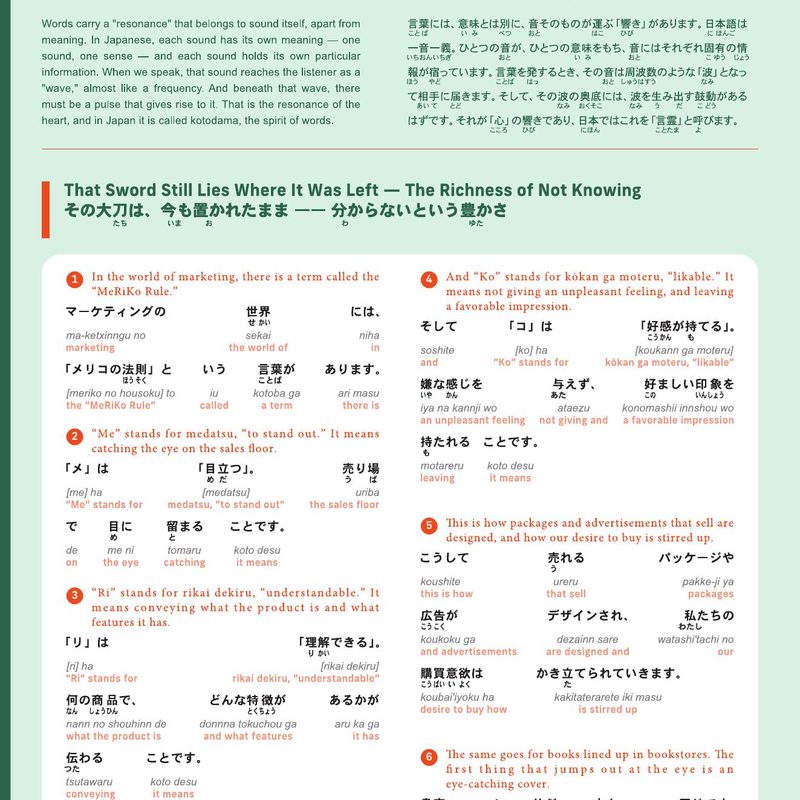
Today’s word comes from an essay about a sword. In the December 2026 issue of Hiragana Times, a bilingual magazine published in Japan since 1986, the NIHONGO DO® Voice Wave column is titled その大刀は、今も置かれたまま (Sono tachi wa, ima mo okareta mama) — “That Sword Still Lies Where It Was Left.” It reads a poem that the hero Yamato Takeru composed as his life was coming to an end, recorded in the Kojiki, Japan’s oldest history book.
Leaving the sword Kusanagi with Miyazu-hime, Yamato Takeru fell in battle with the god of Mount Ibuki.
ヤマトタケルは草薙剣を美夜受比売のもとに置いたまま、伊吹山の神との戦いで倒れました。
Yamato Takeru wa Kusanagi no Tsurugi o Miyazu-hime no moto ni oita mama, Ibuki yama no kami to no tatakai de taoremashita.
What remains for us is a heart that savors what we do not understand, just as it is.
私たちに残されているのは、分からないことを、分からないまま味わう心です。
Watashitachi ni nokosarete iru no wa, wakaranai koto o, wakaranai mama ajiwau kokoro desu.
Look at three of the まま in the essay. 置いたまま (oita mama): Yamato Takeru left the sword with Miyazu-hime and went into battle without it — the English says “Leaving.” The title says 置かれたまま (okareta mama): 置かれた is the passive of 置く (oku, to put), so the sword “still lies where it was left.” And the essay ends with 分からないまま (wakaranai mama) — savoring what we do not understand “just as it is.” One small word; three English translations: leaving, still, just as it is.
Your Voice | What did you do with something still on?
[thing]を[verb た-form]まま、[action]。
[thing] o [verb ta-form] mama, [action].
I did [action] with [thing] still [on / open / in place].
- Think of one time you did something with something still on, open or in place.
- Put it into the pattern above — the た-form, then まま, then what happened.
- Read it aloud, then say it without looking.
昨日、テレビをつけたまま寝てしまいました。めがねをかけたまま、顔を洗ったこともあります。
Kinō, terebi o tsuketa mama nete shimaimashita. Megane o kaketa mama, kao o aratta koto mo arimasu.
Yesterday, I fell asleep with the TV on. I have also washed my face with my glasses on.
Write your answer in the comments below — a We coach will reply.
Speak Your Language | Make 〜たまま yours
Practice is not the goal. The goal is to make 〜たまま your own word — and say what you really feel, in Japanese.
A new language gives you a new way to see the world, and a new self. Other lessons stop at a formula: “た-form + まま = as it is.” We start from the night you fell asleep with the light on, and take you all the way to a sword that still lies where it was left — and to 分からないまま, enjoying what you don’t understand, just as it is. That’s We.
Speak Your Language.