
TODAY’S WORD
単刀直入
tantō-chokunyū
8 beats: ta-n-to-o-cho-ku-nyu-u
単刀直入に言うと tantō-chokunyū ni iu to = to put it bluntly
“getting straight to the point” — no warm-up, no small talk
A café, a Friday evening. Your friend has been talking about the weather, the coffee, the traffic — and then stops, takes a breath, and says: “単刀直入に言うと……” (Tantō-chokunyū ni iu to… — To put it bluntly…)
You put your cup down. Whatever comes next is the real reason you are here. That is 単刀直入 (tantō-chokunyū): skipping the lead-up and going straight to the point. Four kanji, and one of them is a sword.
Say one thing you really mean — straight to the point — starting with 単刀直入に言うと.
Read & Say | 単刀直入
Written in hiragana, 単刀直入 is たんとうちょくにゅう. It has 8 beats. In Japanese, each beat takes the same length of time.
- ん (n) is a full beat on its own. Hold it as long as た.
- とう is a long ō (to-o), and にゅう is a long ū (nyu-u). The う simply makes the vowel before it twice as long.
- ちょ (cho) and にゅ (nyu) are one beat each — the small ょ and ゅ join the sound before them.
- It helps to think of it in two halves: tantō · chokunyū — then say it smoothly in one go.
Straight in, or warm up first?
Think first: When you have something important to say — bad news, a big request, an honest opinion — do you go straight to the point, or do you warm up first? And when someone talks to you, which do you prefer? How do people in your own language signal “I’m about to be frank”?
How 単刀直入 works
単刀直入 is a yojijukugo — a four-kanji compound. Read the kanji one by one and you can see the picture inside it:
The image is a lone fighter with a single sword, charging straight in — no circling, no feints. Today, nobody carries a sword, but the phrase still means the same thing: going straight to the main point.
In everyday Japanese, you will hear it in two shapes. Add に (ni) and it describes how you say or ask something. Add な (na) and it describes a noun.
単刀直入に + verb
tantō-chokunyū ni + verb
(say / ask) directly, frankly
単刀直入な + noun
tantō-chokunyū na + noun
a direct (question, answer…)
単刀直入に言うと、無理です。
Tantō-chokunyū ni iu to, muri desu.
To put it bluntly, it’s not possible.
単刀直入に聞きますが、いくらですか?
Tantō-chokunyū ni kikimasu ga, ikura desu ka?
I’ll ask you directly: how much is it?
単刀直入な質問ですね。
Tantō-chokunyū na shitsumon desu ne.
That’s a very direct question.
| Situation | Japanese |
|---|---|
| with friends | 単刀直入に言うね。 Tantō-chokunyū ni iu ne. — I’ll just say it. |
| polite | 単刀直入に言います。 Tantō-chokunyū ni iimasu. — I’ll be direct. |
| at work, very polite | 単刀直入に申し上げますと…… Tantō-chokunyū ni mōshiagemasu to… — To be frank with you… |
A real-life note: look closely and 単刀直入に言うと is itself a tiny warm-up. It doesn’t skip the warning — it is the warning: “Something frank is coming.” Some people say that is exactly why it works in Japanese: you get to be direct, and the listener still gets a second to prepare. Others hear it simply as a quick way to save time. Either way, the words that follow are the point.
Everyday 単刀直入
| Word | Meaning |
|---|---|
| 単刀直入に言うと tantō-chokunyū ni iu to | to put it bluntly; let me get to the point |
| 単刀直入に聞きますが tantō-chokunyū ni kikimasu ga | I’ll ask you directly, but… |
| 前置き maeoki | preamble; the lead-up before the main point |
| 本題に入る hondai ni hairu | to get to the main point |
| はっきり言うと hakkiri iu to | to put it plainly |
単刀直入 in a conversation
Two friends at a café. A has news, but can’t quite start.
Aあのね、ちょっと話があって……。
Ano ne, chotto hanashi ga atte…
Um, there’s something I want to tell you…
Bなに? 単刀直入に言って。
Nani? Tantō-chokunyū ni itte.
What is it? Just say it.
Aじゃあ、単刀直入に言うね。来月、日本に引っ越すんだ。
Jā, tantō-chokunyū ni iu ne. Raigetsu, Nihon ni hikkosu n da.
OK, I’ll get straight to the point. I’m moving to Japan next month.
Bえっ、本当に? すごい!
E, hontō ni? Sugoi!
What, really? That’s amazing!
B asks for the point (単刀直入に言って). A takes one breath with the same phrase (単刀直入に言うね) — and then says it.
Quiz | 単刀直入
Q1. How many beats are in 単刀直入?
Answer
c) 8 — た・ん・と・う・ちょ・く・にゅ・う.
Q2. “To put it bluntly…” Which particle goes in the gap?
単刀直入( )言うと……
Answer
a) に — 単刀直入に tells you how someone speaks.
Q3. Which kanji in 単刀直入 means “sword”?
Answer
b) 刀 (tō). On its own, the same kanji is read 刀 (katana).
Q4. A colleague says 単刀直入に言うと、この案は難しいです。 (Tantō-chokunyū ni iu to, kono an wa muzukashii desu.) What is she telling you?
Answer
“To be frank, this plan is going to be difficult.” In Japanese, 難しい here is often a polite way of saying “no.” She warned you first — then gave you her honest view.
単刀直入 — one of nine sword words
FROM HIRAGANA TIMES
Today’s word comes from a magazine page. In the December 2026 issue of Hiragana Times, a bilingual magazine published in Japan since 1986, the Word Leaves column, “Words the Sword Has Honed” (刀が磨いた言の葉), collects nine words built on the kanji 刀 — from practice swords to the operating room to everyday speech. 単刀直入 is the last of the nine.
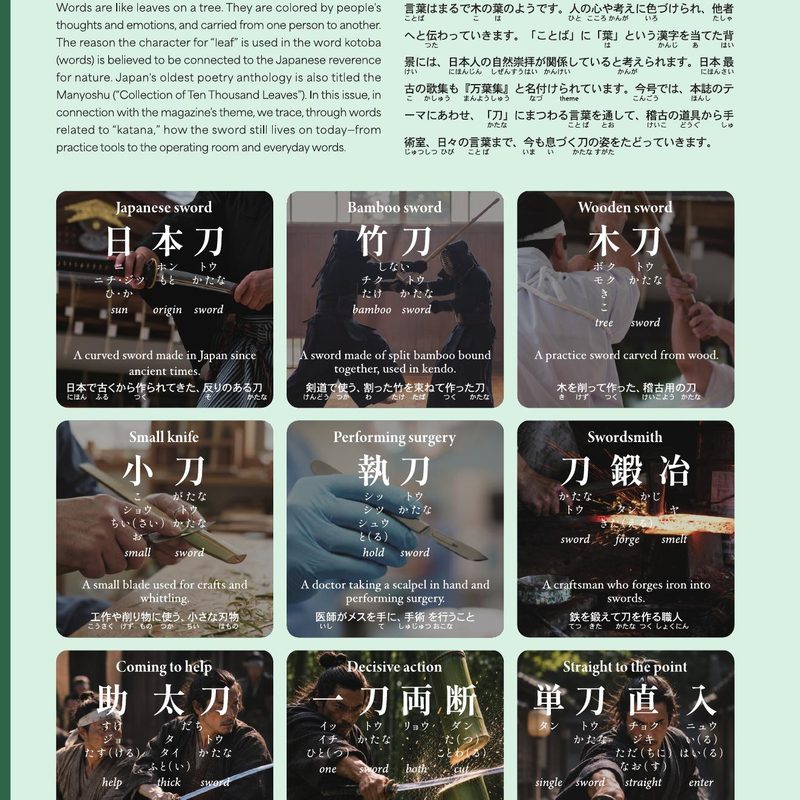
Words are like leaves on a tree. They are colored by people's thoughts and emotions, and carried from one person to another.
言葉はまるで木の葉のようです。人の心や考えに色づけられ、他者へと伝わっていきます。
Kotoba wa marude ki no ha no yō desu. Hito no kokoro ya kangae ni irozukerare, tasha e to tsutawatte ikimasu.
Straight to the point: Getting right to the main point without any preamble.
単刀直入:前置きなしに、いきなり本題に入ること
Tantō-chokunyū: maeoki nashi ni, ikinari hondai ni hairu koto.
Look at how the nine words read the same kanji. On its own, 刀 is katana, and it stays katana in 刀鍛冶 (katanakaji, swordsmith); in 小刀 (kogatana, small knife) it softens to gatana. In 日本刀 (nihontō), 木刀 (bokutō) and today’s 単刀直入, it is tō. In 助太刀 (sukedachi, coming to help), it hides inside dachi. And 竹刀, the bamboo sword of kendo, is simply read shinai as a whole word.
Your Voice | What would you say 単刀直入に?
単刀直入に言うと、[what you really mean]。
Tantō-chokunyū ni iu to, [what you really mean].
To put it bluntly, [what you really mean].
- Think of one thing you have been wanting to say — to a friend, a teacher, or yourself.
- Start with 単刀直入に言うと, then say it in one short sentence.
- Read it aloud, then say it without looking.
単刀直入に言うと、もっと日本語で話したいです。教科書の日本語だけでは足りません。
Tantō-chokunyū ni iu to, motto Nihongo de hanashitai desu. Kyōkasho no Nihongo dake de wa tarimasen.
To put it bluntly, I want to speak more Japanese. Textbook Japanese alone isn’t enough.
Write your answer in the comments below — a We coach will reply.
Speak Your Language | Make 単刀直入 yours
Practice is not the goal. The goal is to make 単刀直入 your own word — and say what you really feel, in Japanese.
A new language gives you a new way to see the world, and a new self. Other lessons stop at a dictionary line: “tantō-chokunyū = straightforward.” We start from the moment a friend takes a breath and says 単刀直入に言うと…… — and teach you to be direct in Japanese without sounding cold, from 単刀直入に言うね with friends to 単刀直入に申し上げますと at work. That’s We.
Speak Your Language.