
Japanese Training for Your International Employees
Built for real Performance on the Job
We Japanese Training Program
From daily exchanges and face-to-face interactions to internal coordination — build the language skills to communicate clearly across every workplace situation.

Strengthen the practical Japanese needed for meetings, reports, presentations, and client interactions — boosting precision and credibility in professional settings.

A structured approach toward target scores and certification benchmarks — supporting learners in achieving the qualifications and performance milestones that matter.

All training is built around these three pillars.
The diverse range of classes organized across these areas makes it possible to address virtually any professional Japanese learning goal.
Building workplace Japanese, step by step — aligned with real tasks
We Languages designs Japanese training around the work your international employees actually need to do — not a fixed textbook sequence. From day-to-day workplace coordination to client meetings and presentations, individual and group programs are tailored to each role, workplace, and goal.
Each class is structured around 12 lessons per term as a baseline, with options for extended engagement. We help learners build Japanese that works — day after day, task after task.
Individual Training & Group Training
Individual Training
One-on-one training designed around each learner's specific role and workplace demands. Sessions focus directly on the tasks, challenges, and scenarios that matter most — enabling rapid improvement and targeted skill development.
Whether it's interviews, negotiations, presentations, or on-site interactions, Individual Training builds the kind of practical Japanese fluency that makes an immediate difference. Training is tailored to the individual's level and responsibilities, supporting overall organizational performance.

| Lessons | Points | Use Cases |
|---|---|---|
| 12 L | 24 pt (40 min/session) 36 pt (60 min/session) |
On-site communication skills Language training for managers & team leads Presentation & negotiation preparation Onboarding support for international staff Exam preparation (JLPT, etc.) Addressing individual learning needs |
| 24 L | 48 pt (40 min/session) 72 pt (60 min/session) |
|
| 36 L | 72 pt (40 min/session) 108 pt (60 min/session) |
Group Training
Team-based training designed for organizations. Content is built around a shared work environment and common objectives — aligning team understanding and strengthening internal coordination.
With curricula structured around Workplace Communication, Business Communication, and Exam Preparation, Group Training systematically develops the Japanese proficiency that drives real results. Ongoing training improves the speed and accuracy of communication across the entire organization.

| Lessons | Points | Training Structure |
|---|---|---|
| 12 L | 12 pt (60 min/session) 24 pt (90 min/session) |
Training built on three pillars: Workplace Communication Business Communication Exam Preparation Customizable by environment, level & goals |
| 24 L | 24 pt (60 min/session) 48 pt (90 min/session) |
|
| 36 L | 36 pt (60 min/session) 72 pt (90 min/session) |
Workplace Communication Program
Build the Japanese skills to coordinate clearly within teams and across the workplace — without gaps, without misreads.
Build a foundation for internal coordination
Through scenarios drawn from daily workplace situations — on-site interactions, visitor reception, internal coordination — learners develop the Japanese needed to communicate smoothly within their organization.
Support safe, accurate task execution
Centered on the exchanges that come up most in the workplace — requests, confirmations, explanations, updates — this program develops the expression and response skills to prevent misunderstandings and keep work moving accurately.
Progress at a pace that connects to real work
Each level is designed with the learner's stage of development and practical usability in mind. From foundational to advanced, learners build workplace Japanese step by step — always with real application in sight.
Adaptable to role and purpose
The expressions and skills that matter most vary depending on the job, the team, and the situation. Training is designed around specific objectives — developing Japanese that actually works in each learner's workplace.
Each level class is structured around 12 lessons (24 points) per term, with options to continue up to 36 lessons (72 points) in progressive stages.
Program Structure
Smoothing coordination with colleagues, supervisors, and across departments — supporting safe, aligned task execution.
Basic workplace responses, confirmations, and self-introduction
Internal coordination and day-to-day operational communication
Reporting, explaining, consulting, and sharing updates
Internal coordination, complex explanations, and aligning understanding
Advanced internal communication, trust-building, and cross-cultural collaboration
Business Communication Program
Build the Japanese communication skills to move business forward — centered on relationship development with clients and partners.
Strengthen practical communication with clients and partners
Develop the Japanese proficiency needed in professional settings — meetings, reports, consultations, presentations, and client interactions — to operate with confidence and credibility.
Refine expressions that build trust
Beyond keigo and word choice, learners develop communication skills attuned to the relationship and business context — deepening connections without damaging trust.
Sharpen the ability to communicate and coordinate effectively
Through exchanges involving explanations, confirmations, updates, and adjustments, learners build practical skills for moving business forward smoothly with clients and partners.
Design training around each role and objective
The communication skills required vary by position, responsibility, and business context. Training is built around specific goals — developing Japanese that performs in the real business environment.
Each level class is structured around 12 lessons (24 points) per term, with options to continue up to 36 lessons (72 points) in progressive stages.
Program Structure
Centered on building relationships with clients and partners — strengthening the business communication skills needed for proposals, coordination, and reaching agreement.
Foundational responses and relationship-building for business
Essential operations for business communication
Explaining, coordinating, and building trust
Proposing, coordinating, and reaching agreement
Advanced business communication, trust-building, and cross-cultural collaboration
Exam Preparation Program
Build on real language proficiency — use exams to make your ability visible and carry that momentum into the next stage of growth.
Turn practical proficiency into recognized ability
Starting from the Japanese you already use at work, this program systematically develops the vocabulary, grammar, reading, and listening skills required by formal exams — refining real-world proficiency into a form that can be assessed and certified.
Use exams to understand where you stand
The clear, objective benchmarks that exams provide help learners identify their strengths and gaps — making it easier to see what to focus on next and how to get there.
Sustain a study plan and keep motivation high
A concrete goal — passing a level or hitting a target score — gives direction to study and builds the consistency that leads to lasting growth. Staged goal-setting supports steady, measurable progress.
Preparation designed around your target
Training covers JLPT and other major proficiency exams, with content tailored to the learner's level and objectives. Skill development and result achievement go hand in hand.
Each level class is structured around 12 lessons (24 points) per term, with options to continue up to 36 lessons (72 points) in progressive stages.
Program Structure
Programs are designed around the JLPT framework, aligned with each stage of practical Japanese proficiency development.
Establishing foundational understanding and basic communication
Foundational proficiency for everyday tasks
Practical proficiency for workplace use
Advanced communication ability for the business environment
Advanced judgment, expression, and trust-building
Looking for a training approach that fits how your organization works?
We'll help you find the right program for your team.From initial questions to mapping out how training would run — feel free to reach out at any stage.
Book a consultationWe Method & Approach
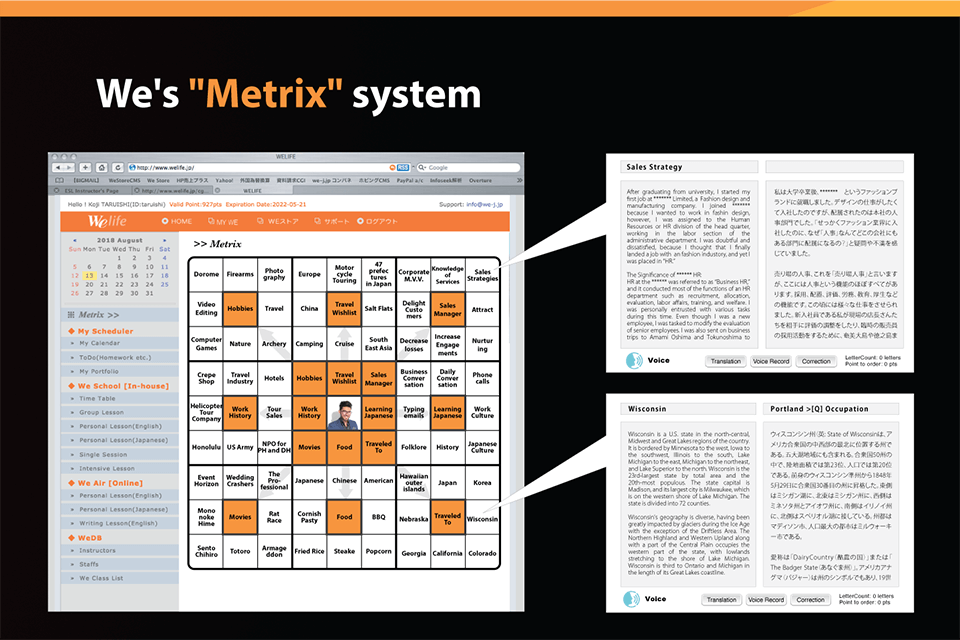
A practical training platform — designing the Japanese each learner actually needs
Learner-Centered Training DesignSince its founding, We Languages has placed learner-centered training design at the core of everything it does. That commitment is the foundation of our proprietary "Metrix" method.
This method makes it possible to design language learning not around textbook progression, but around the themes and contexts that are genuinely relevant to each learner's life, work, and interests.
Our goal is to ensure that the Japanese learners acquire doesn't stop at knowledge — it takes root as a living skill they can use in their own workplace and daily life.
Acquiring a language means developing a new capacity for expression — one that works where it matters.
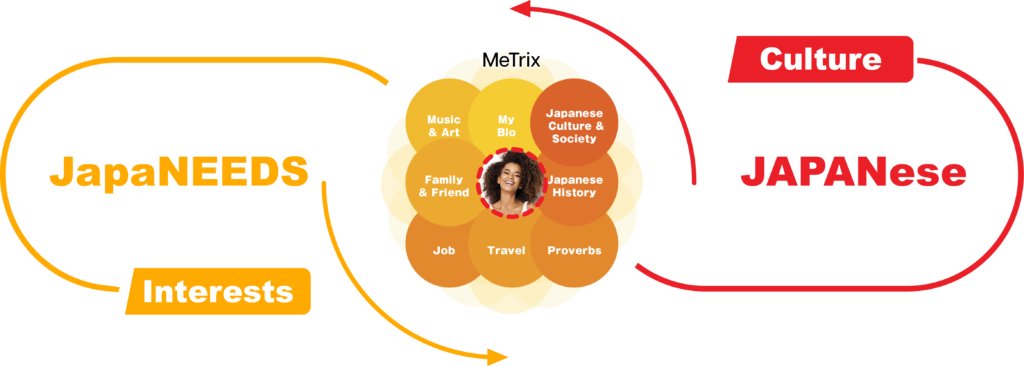
Individually optimized training — designed around each learner's needs
Through We's proprietary Metrix system, we design the JapaNEEDS of each individual learner. Rather than fitting learners to the curriculum, we build the curriculum around each learner's goals and background.
Lessons draw on real examples from everyday life, work, and areas of interest — prioritizing relevance and practical usefulness. Individualized content leads to deeper understanding, greater continuity, and knowledge that can actually be applied.
Learning design that turns language into usable ability
True language acquisition requires more than vocabulary and grammar. It calls for an understanding of the cultural context and nuance in which the language is actually used.
At We, language is not treated as a mere tool. We develop it as a force for expressing one's own thinking and intentions — and for building relationships with others.
As a result, learning extends beyond knowledge acquisition into the development of real-world responsiveness, conversational ability, and expressive range.
The value of language learning lies in turning understanding into the ability to use it — in real situations, with real people.
We Language Theory — "Language Diamond"
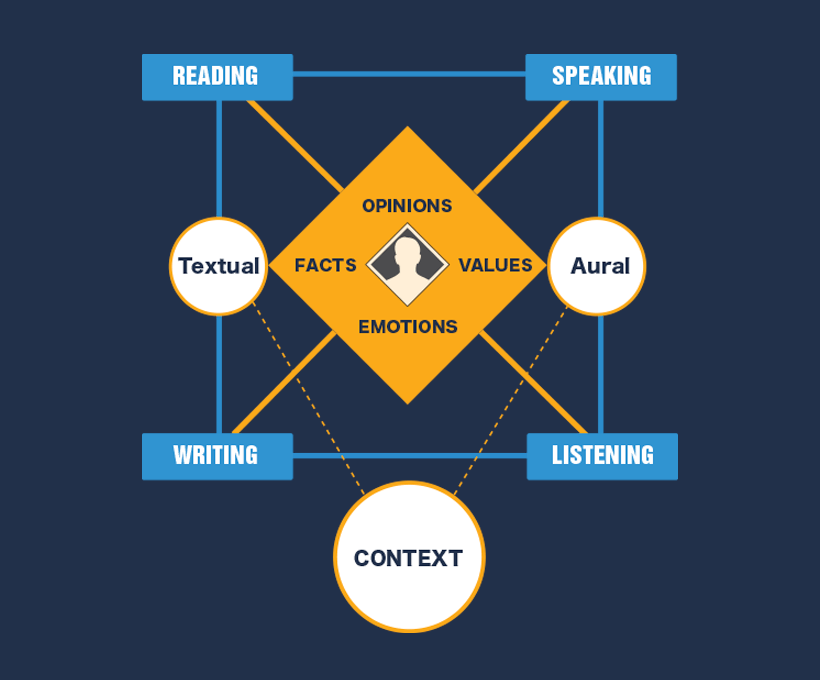
At We Languages, we have continually refined our approach to ensure that learning doesn't end when the lesson does — and that learners keep growing beyond the classroom. That effort led us to Language Diamond: a theory of learning design built around the goal of developing independent, self-sustaining learners.
What matters most is that each learner acquires the Japanese they genuinely need — for their own life and work. When that happens, what is learned doesn't remain abstract knowledge. It becomes language the learner can own and use as their own.
Learning built on Language Diamond goes beyond pattern practice. It develops the full range of expression — opinions, feelings, facts, and values. And because lessons are built around each learner's interests and goals rather than a fixed curriculum, they lead directly to more practical, real-world communication ability.
We Learning Structure
We designs Japanese training tailored to each individual learner — grounded in the Language Diamond framework.
Japanese training that moves forward — shaped around each learner's purpose.
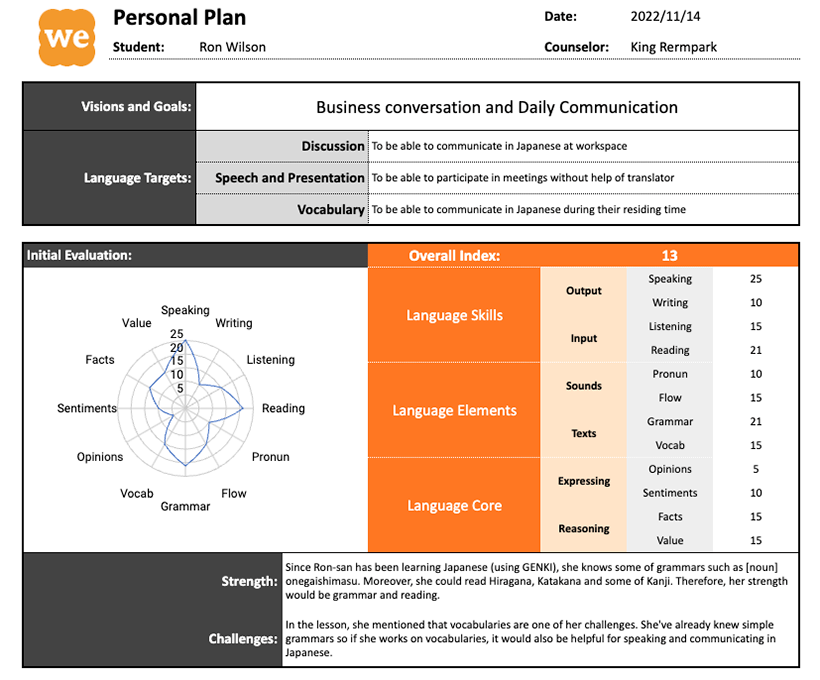
Learning at We begins with an evaluation framework built around the Language Diamond — establishing a clear picture of where each learner is and what they need.
At the center of this framework is not simply the language to be learned, but the question: "What Japanese does this person actually need?" That perspective shapes everything.
Developing Japanese proficiency at We is not about accumulating knowledge. It means strengthening the ability to communicate your own thinking — and connecting that ability to practical use in work and daily life.
Bespoke Japanese training — tailored to each learner's purpose, background, and interests.
Training designed to turn every session into results
The WWW Training Design — built for results
Every session delivers. That is We's training policy. To ensure that each session builds reliably toward results, training is structured around three "W"s.
The first stage — "Warm Up" — is preparation for results. Learners shift their awareness, understanding, and focus into Japanese mode, ready to engage.
The second stage — "Work Up" — is where results are actually produced. Through understanding, practice, and active use, learning content is connected to real performance.
The final stage — "Wrap Up" — is where results are confirmed and retained. Learners review what was covered and organize it in a way that can be carried forward into future sessions.
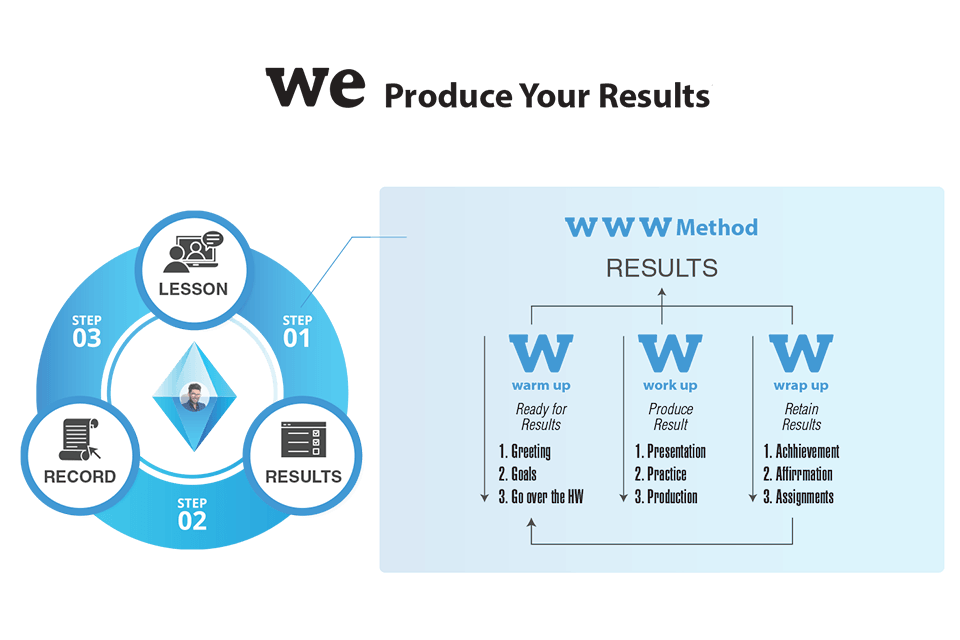
The We WWW method is designed so that every learning session leads to results. By setting a clear goal each time and progressing through its achievement, small wins accumulate steadily over time.
That accumulation is what sustains learner confidence and consistency — and what drives the development of Japanese that can actually be used.
Three W's — turning every session into a reliable step toward results.
J-CLUE — Making Japanese Proficiency and Japan Literacy Visible
J-CLUE Japanese Culture and Language Understanding Evaluation

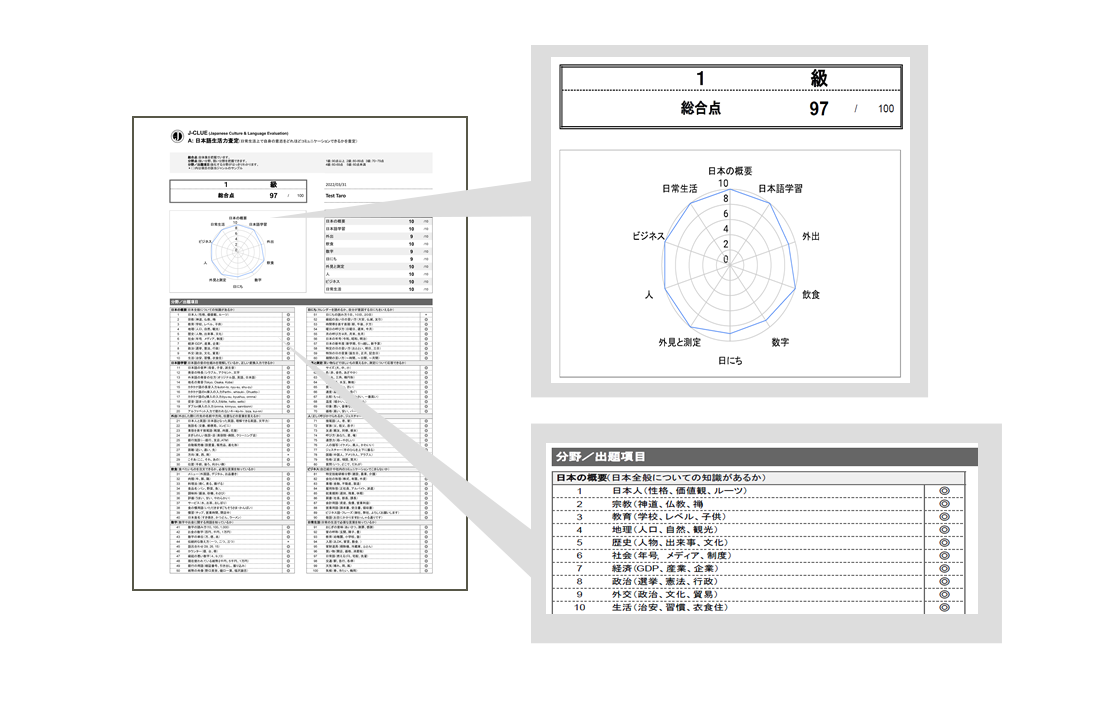
J-CLUE is an online diagnostic tool for Japanese language learners, designed to make both Japanese language proficiency and understanding of Japan visible. Rather than a simple vocabulary or grammar test, its purpose is to measure how learners actually understand and use Japanese in real life and in society.
Questions are designed to cover not only language knowledge, but also Japanese customs, seasonal awareness, etiquette, and social common sense. The process of selecting answers itself becomes a learning experience — a starting point for understanding language and culture as one.
J-CLUE also features a multilingual design that accounts for each test-taker's country of origin and native language — working toward a more equitable assessment of understanding, free from disadvantage based on linguistic background.
A: Japanese Daily Life Proficiency AssessmentFree
Diagnoses how well learners can express their thoughts and feelings in Japanese in the context of everyday life. Goes beyond basic vocabulary to assess understanding of daily customs, manners, and social behavior — providing a comprehensive picture of practical life-based Japanese proficiency.
Try the free assessmentB: Japanese Fluency Assessment
Diagnoses how naturally and appropriately learners can communicate in Japanese. Centered on speaking and listening, it measures situation-specific phrasing, responsiveness, and the expressive ability required in professional and interpersonal contexts.
(¥3,850 incl. tax / person)C: Japanese Script Proficiency Assessment
Diagnoses reading and writing ability across hiragana, katakana, and kanji, as well as the practical literacy needed for Japanese input and document creation. Assesses not just foundational script knowledge, but the operational ability to use it in daily work and learning.
D: Japanese Cultural Literacy Assessment
Provides a comprehensive diagnosis of both Japanese language proficiency and understanding of Japanese society, culture, geography, history, politics, and economics. Balancing knowledge and cultural fluency, it makes visible the breadth of Japan understanding needed for long-term success and integration.
| Grade | Score | Description |
|---|---|---|
| Grade 1 | 90+ | Communicates in everyday situations with little difficulty. Demonstrates deep understanding of Japan-specific culture and customs, and the ability to behave naturally within Japanese society. |
| Grade 2 | 80–89 | Has a solid grasp of basic vocabulary, sentence patterns, and Japanese culture, history, and customs. Can communicate effectively in daily life. Shows awareness of context and the ability to understand others' perspectives. |
| Grade 3 | 70–79 | Basic communication is possible, but cultural understanding and expressive flexibility need development. Has the ability to convey information, but natural interaction requires continued learning. |
| Grade 4 | 60–69 | Can manage basic exchanges independently, but shows uncertainty in context-appropriate expression and behavior. Reading reactions and subtext fully requires further experience and learning. |
| Grade 5 | 50–59 | Minimum communication in Japanese is possible but relies primarily on support. Requires ongoing training in both linguistic expression and cultural understanding. |
| Below Standard | 49 or below | Day-to-day Japanese interaction remains challenging. Foundational learning is needed to develop both language ability and adaptability to Japanese culture and context. |
A: Japanese Daily Life Proficiency Assessment (Free)
This section diagnoses understanding of daily life customs and culture in Japan, as well as basic communicative ability in Japanese. The assessment is available online in multiple languages, with three test formats to choose from: the test-taker's native language, hiragana/katakana, or standard Japanese.
100 questions (6 categories · 4 choices · 1 point each) | Approx. 40–50 minutes
- Language25 questions
- Everyday Life20 questions
- Culture & Society20 questions
- Business & Work15 questions
- Geography10 questions
- History10 questions
Making Japanese proficiency and Japan understanding visible — and connecting that clarity to growth.
Content Partner
The Synergy of Hiragana Times

At We Languages, we enrich the language learning experience through our content partnership with Hiragana Times. As a bilingual magazine, Hiragana Times allows learners to develop language skills while deepening their understanding of Japanese culture. Japanese paragraphs are paired with English translations, and kanji are accompanied by furigana readings. Audio content narrated in both English and Japanese is also available. Through the full integration of Hiragana Times into our program, We Languages offers a high-end online Japanese learning experience that goes beyond conventional boundaries — guiding learners further into the language and the culture that surrounds it.
Bilingual Text
Every Japanese paragraph is matched with an English translation. Kanji include furigana readings, helping learners build natural reading comprehension.
Audio Content
Audio narration in both English and Japanese reinforces learning from both a listening and pronunciation perspective.
Deep Cultural Understanding
Articles on Japanese society, culture, and current affairs go beyond language skill — offering learners exposure to Japanese as it is actually lived and used.
Through our partnership with Hiragana Times, Japanese language learning goes deeper — and richer.
We Japanese Training Team

A Standardized Training System
All We coaches are practitioners who have completed our proprietary PLC training. Grounded in shared instructional principles and evaluation standards, every coach delivers training at a consistent level of quality. Progress is shared across the team, ensuring continuous and stable learning support for every learner.

Every Coach Has Learned a Foreign Language
Every We coach has personal experience learning a foreign language. That means they genuinely understand the moments of confusion and uncertainty that learners face — and can provide support with real empathy. Taking linguistic background and cultural difference into account, each coach tailors their explanations and feedback to the individual.
Results Made Visible in Every Session
At We, every session is designed as a process that leads to results. By setting a clear goal each time and confirming its achievement as the session progresses, learning accumulates in a steady, reliable way. This builds learner confidence and consistency — and connects directly to the development of Japanese that can be used in real situations.
A standardized system and experienced coaches — delivering training you can count on.
Browse coach profiles — right from the portal.
In language learning, results aren't determined by method alone. At We, we believe that who you learn from matters just as much as how you learn.
That's why we've built a system that makes it easy to find the right match — taking into account compatibility with each learner's needs, areas of expertise, teaching experience, and multilingual background.
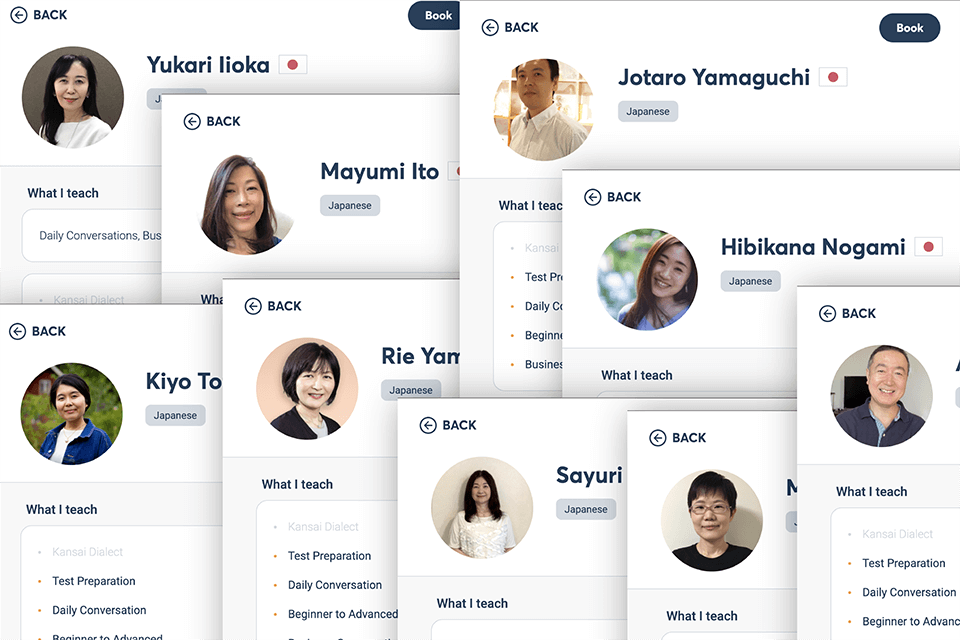
Through Welife — the dedicated portal for We learners — you can browse the full profile of each coach before you begin. This makes it easy to identify coaches who are well-suited to your learning goals and areas of interest.
Being able to review potential coaches in advance leads to more confident, well-considered selections — whether for individual learners or organizations enrolling multiple participants.
Create a free account and browse coachesBrowse coaches at your own pace — and find the right fit for your learning needs.
Welife — Learning Management Platform
A platform for managing the Japanese learning each person needs.
Welife is a platform that centralizes and manages Japanese language learning tailored to each individual learner — entirely online.
Beyond lesson scheduling and progress tracking, it brings together everything needed for learning: advance communication with coaches, assignment review, and a full record of lesson history — all in one place.
For individual learners, Welife makes it easier to maintain a consistent, personalized learning routine. For organizations with multiple participants, it provides clear visibility into enrollment status and progress across the group.
Welife functions as the foundation that keeps learning from stopping at the end of each session — connecting every lesson to ongoing, cumulative results.
Create a free account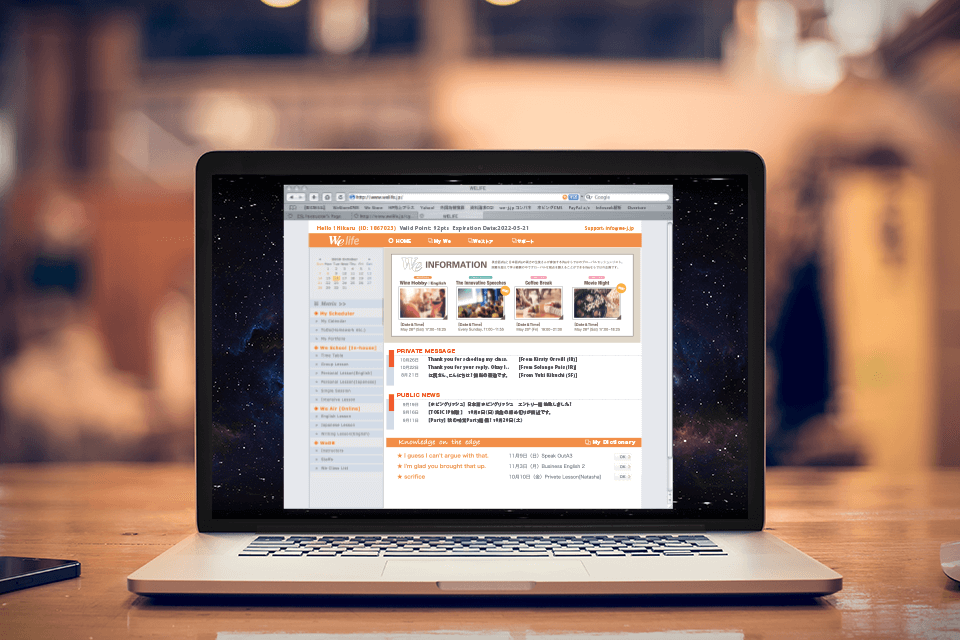
With Welife, continuity and results stay organized — in one platform.
Looking for a training approach that fits how your organization works?
We'll help you find the right program for your team.From initial questions to mapping out how training would run — feel free to reach out at any stage.
Book a consultation