

TODAY’S WORD
なつかしい
natsukashii
5 beats: na-tsu-ka-shi-i
なつかしい! = This brings back memories! 〜がなつかしい ga natsukashii = I fondly remember ~
the warm, slightly aching feeling when something from your past comes back
A café in Tokyo, a long way from home. You are halfway through a sentence in Japanese when a song comes on — the song you played every day when you were sixteen. You stop talking. Your Japanese friend looks at your face, smiles, and says one word: “なつかしい?” (Natsukashii? — Does that take you back?)
You nod. In English you might need a whole sentence: “Oh, this brings back memories.” Japanese packs that moment — the song, the old days, the little ache — into one word: なつかしい (natsukashii).
Say what makes you feel なつかしい — and know when Japanese uses a different word for simply missing someone.
Read & Say | なつかしい
なつかしい has 5 beats. In Japanese, each beat takes the same length of time — including the last い.
- つ (tsu): the “ts” of “cats,” then a short u. Between ts and k, many speakers almost whisper that u, so it can sound like “nats-kashii.”
- し・い (shi-i): keep both beats. Cutting it to “natsukash” makes it sound unfinished.
- In writing, you will also see it with a kanji: 懐かしい. Same word, same reading.
What takes you back?
Think first: Think of one song, one taste or one smell that pulls you straight back to another time or place. Where does it take you? How would you say that feeling in your own language — in one word, or in a whole sentence?
How なつかしい works
なつかしい is an い-adjective (i-adjective). English usually says how you feel (“I miss…”, “I feel nostalgic”) or what the thing does to you (“This brings back memories”). Japanese simply describes the thing as なつかしい — and “I” usually goes unsaid.
⇄
子どものころがなつかしいkodomo no koro ga natsukashii — I fondly remember my childhood
[thing]、なつかしい!
[thing], natsukashii!
[thing] brings back memories! — said the moment you see, hear or taste it
[thing]がなつかしい
[thing] ga natsukashii
I fondly remember [thing] / I feel nostalgic for [thing]
なつかしい[noun]
natsukashii [noun]
a [noun] from back then — なつかしい味 (natsukashii aji), a taste from your past
| Form | Japanese | Meaning |
|---|---|---|
| plain | なつかしい natsukashii |
brings back memories |
| polite | なつかしいです natsukashii desu |
(polite) |
| past | なつかしかった natsukashikatta |
it brought back memories |
| not | なつかしくない natsukashiku nai |
it doesn’t take me back |
The trap — “I miss you” is not なつかしい: なつかしい looks back at something from your past, usually because something in front of you has just brought it back. When you simply miss someone who is far away now and want to see them, Japanese usually says 会いたい (aitai, I want to see ~) or 恋しい (koishii, to miss, to long for). 家族に会いたい (kazoku ni aitai) is “I miss my family.” 家族がなつかしい can sound as if your family belonged to a distant past.
Everyday なつかしい
| Word | Meaning |
|---|---|
| なつかしい歌 natsukashii uta |
a song from back then |
| なつかしい味 natsukashii aji |
a taste that takes you back (often home cooking) |
| 子どものころ kodomo no koro |
when I was a child |
| ふるさと furusato |
hometown, the place you come from |
| 思い出す omoidasu |
to remember, to be reminded of |
| 恋しい koishii |
to miss, to long for (someone or something absent now) |
なつかしい in a conversation
Two friends in a café. A song starts playing.
Aあ、この曲!
A, kono kyoku!
Oh, this song!
B知ってるの?
Shitteru no?
You know it?
Aうん、高校のころ、毎日聞いてた。なつかしい!
Un, kōkō no koro, mainichi kiiteta. Natsukashii!
Yeah, I listened to it every day in high school. That takes me back!
Bふるさとが恋しくなった?
Furusato ga koishiku natta?
Missing home now?
Aちょっとね。
Chotto ne.
A little.
The song is なつかしい — it brings the past back. Home, far away right now, is 恋しい.
Quiz | なつかしい
Q1. How many beats are in なつかしい?
Answer
b) 5 — な・つ・か・し・い.
Q2. A song from your school days comes on. What do you say?
Answer
a) なつかしい! さびしい means lonely; あたらしい means new.
Q3. “That brought back memories.” Which past form is correct?
Answer
a) — for an い-adjective, い becomes かった. For polite past, add です: なつかしかったです.
Q4. Your friend lives far from her family and wants to see them soon. Which fits better?
Answer
a) — she misses them now and wants to see them. b) can sound as if her family belonged to a distant past.
大和しうるはし — a dying prince sings of home
FROM HIRAGANA TIMES
Today’s word leads to a very old story. The December 2026 issue of Hiragana Times, a bilingual magazine published in Japan since 1986, tells the legend of Yamato Takeru, a prince sent to fight in lands far from his home, Yamato. On the way back, he fell ill and died far from home. This is how the article ends.
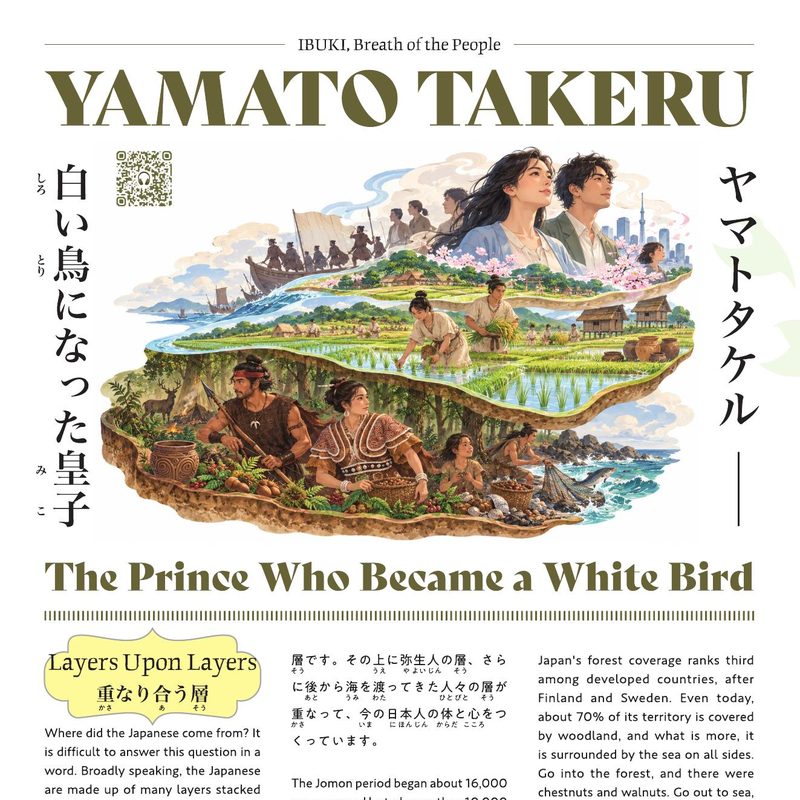
After Yamato Takeru breathed his last, a single white bird took flight from his tomb. The white bird flew on toward the distant sky of Yamato.
ヤマトタケルが息を引き取ったあと、墓から一羽の白い鳥が飛び立ちました。白い鳥は、遠い大和の空をめざして飛んでいきます。
Yamato Takeru ga iki o hikitotta ato, haka kara ichiwa no shiroi tori ga tobitachimashita. Shiroi tori wa, tōi Yamato no sora o mezashite tonde ikimasu.
大和は 国のまほろば たたなづく 青垣 山隠れる 大和しうるはし
Yamato wa / kuni no mahoroba / tatanazuku / aogaki / yamagomoreru / Yamato shi uruwashi
(Yamato is the finest place among all lands. Surrounded by mountains layered like green fences, Yamato is truly beautiful.)
This is the poem Yamato Takeru composed in his final moments.
ヤマトタケルが、最期に詠んだ歌です。
Yamato Takeru ga, saigo ni yonda uta desu.
Notice what the poem does not say. There is no なつかしい, no “I miss home.” The dying prince simply names what he remembers — the green mountains layered like fences, the land of Yamato — and calls it beautiful. That is often how なつかしい works in everyday Japanese, too: you don’t explain the feeling, you name the thing that brings it back. この歌、なつかしい。
Two reading notes: in this old poem, は in 大和は is read wa, as it still is today; and うるはし is written in old spelling but read uruwashi — “beautiful, lovely.”
Your Voice | What feels なつかしい to you?
[thing]がなつかしいです。
[thing] ga natsukashii desu.
I fondly remember [thing].
[thing]を聞くと、[place / time]を思い出します。
[thing] o kiku to, [place / time] o omoidashimasu.
When I hear [thing], I think of [place / time].
- Pick one song, taste or smell that takes you back.
- Put it into the patterns above. (For a taste, use 食べると, taberu to, “when I eat.”)
- Read it aloud, then say it without looking.
子どものころに食べた母のスープがなつかしいです。この歌を聞くと、ふるさとを思い出します。
Kodomo no koro ni tabeta haha no sūpu ga natsukashii desu. Kono uta o kiku to, furusato o omoidashimasu.
I fondly remember the soup my mother made when I was a child. When I hear this song, I think of my hometown.
Write your answer in the comments below — a We coach will reply.
Speak Your Language | Make なつかしい yours
Practice is not the goal. The goal is to make なつかしい your own word — and say what you really feel, in Japanese.
A new language gives you a new way to see the world, and a new self. Other lessons stop at “natsukashii = nostalgic.” We start from your own song and your own taste of home, and teach you when Japanese says なつかしい and when it says 会いたい — so that the next time a song stops you mid-sentence, you can say exactly what you feel. That’s We.
Speak Your Language.
Read the full article in Hiragana Times →
Learn Japanese through real Japan with We Languages — book your free counseling →