

TODAY’S WORD
お先に
失礼します
osaki ni shitsurei shimasu
Say it in 11 beats: o-sa-ki-ni shi-tsu-re-i shi-ma-su
お先に osaki ni = before you + 失礼します shitsurei shimasu = excuse me
“I’m heading out” — what you say when you leave the office first
It’s 6 p.m. Your work is done, but everyone around you is still typing. You stand up, pick up your bag… and then what?
In a Japanese office, you don’t just slip out. You say お先に失礼します (osaki ni shitsurei shimasu), “I’m heading out.” And your colleagues answer お疲れ様です (otsukaresama desu), “Don’t work too hard! Take care!”
Say お先に失礼します when you leave, and answer with お疲れ様です.
How to read the Japanese on this page: small hiragana under each kanji show how to read it. Under each Japanese line you’ll find romaji (gray) and English.
Read & Say | お先に失礼します, sound by sound
お先に失礼します has 11 beats. In Japanese, each beat takes the same length of time. The kanji 先 is read さき (saki), and 失礼 is read しつれい (shitsurei) — 4 beats on its own.
- つ (tsu) is one sound, like the “ts” at the end of “cats” followed by a short “u.” Don’t turn it into “soo” or “too.”
- れ・い (re, i) sound almost like one long “reh” — close to English “ray,” but without sliding into the “y.” Keep it two beats long. The Japanese “r” is a light tap of the tongue, between English “r,” “l” and “d.”
- し・す (shi, su): the “i” in the first し and the final “u” in す are barely heard, so the phrase sounds like “osaki ni sh’tsurei shimass.” Still count all 11 beats on your fingers.
What do you say when you leave first? Japanese says osaki ni shitsurei shimasu
Think first: When you leave work, school or a group before everyone else, what do you say — “See you tomorrow,” “Have a good evening,” or nothing at all? And in your workplace, are there rules nobody ever wrote down but everyone follows? A note in any language is fine.
The example sentences, conversation and quiz below were written by We Languages for learning.
Inside the Phrase | お先に + 失礼します
Break the phrase in two and it explains itself. 先 (saki) means “before, ahead,” and the polite お (o) softens it: お先に (osaki ni) = “before you.” 失礼 (shitsurei) means “rudeness,” so 失礼します (shitsurei shimasu) is literally “I commit a rudeness” — in practice, “excuse me.” Put together, it means you are leaving ahead of the others. In English, simply “I’m heading out.”
Three phrases frame the office day: one for arriving, one for leaving first, and the colleagues’ reply. お先に失礼します and お疲れ様です always come as a pair, like a call and its answer.
おはようございます!
Ohayō gozaimasu!
Good morning! (when you arrive)
お先に失礼します。
Osaki ni shitsurei shimasu.
I’m heading out. (when you leave before others)
お疲れ様です。
Otsukaresama desu.
Don’t work too hard! Take care! (the reply)
お疲れ様です comes from 疲れる (tsukareru, to get tired): roughly “you must be tired.” People say it because they care about the other person’s body and mind. So in English it is closer to “Don’t work too hard! Take care!” than to “Good work today,” which sounds like a boss praising staff.
今日はお先に失礼します。
Kyō wa osaki ni shitsurei shimasu.
I’ll be leaving before you today.
The same osaki ni | お先にどうぞ
Keep お先に (osaki ni) and swap the ending, and you get a phrase for letting someone go ahead of you: お先にどうぞ (osaki ni dōzo), “After you.” どうぞ (dōzo) means “please, go ahead.”
お先にどうぞ。
Osaki ni dōzo.
After you.
暗黙のルールがあります。
Anmoku no rūru ga arimasu.
There are unwritten rules.
Key Words | Words around osaki ni shitsurei shimasu
| Japanese | Romaji | English |
|---|---|---|
| お先に失礼します | osaki ni shitsurei shimasu | I’m heading out |
| お疲れ様です | otsukaresama desu | don’t work too hard; take care |
| おはようございます | ohayō gozaimasu | good morning |
| 先に | saki ni | before (others), first |
| 失礼 | shitsurei | rudeness; excuse me |
| 出勤 | shukkin | arriving at work |
| 退勤 | taikin | leaving work |
| 暗黙のルール | anmoku no rūru | unwritten rules |
| 空気 | kūki | air; atmosphere |
Mini Dialogue | Use osaki ni shitsurei shimasu in a conversation
At the end of the day, A leaves before B and says お先に失礼します. This is polite Japanese between colleagues.
A:お先に失礼します。
Osaki ni shitsurei shimasu.
I’m heading out.
B:お疲れ様です。また明日。
Otsukaresama desu. Mata ashita.
Take care! See you tomorrow.
A:明日の会議は9時からですよね?
Ashita no kaigi wa ku-ji kara desu yo ne?
Tomorrow’s meeting starts at nine, right?
B:はい。でも、みんな15分前には来ていますよ。
Hai. Demo, minna jūgo-fun mae ni wa kite imasu yo.
Yes. But everyone gets there fifteen minutes early.
A:なるほど、暗黙のルールですね。
Naruhodo, anmoku no rūru desu ne.
I see. It’s one of those unwritten rules.
- また明日。 (Mata ashita.) = “See you tomorrow.”
- 〜ですよね? (… desu yo ne?) = “…, right?” — used to check something you think is true.
- なるほど (naruhodo) = “I see,” when something has just clicked.
Quiz | osaki ni shitsurei shimasu check
Q1. How many beats does お先に失礼します have?
a) 11 b) 9 c) 7
Answer
a) o-sa-ki-ni-shi-tsu-re-i-shi-ma-su. つ (tsu) counts as one beat, and れ・い (re, i) count as two.
Q2. A colleague leaves the office saying お先に失礼します. What do you reply?
Answer
b) お疲れ様です。 (Otsukaresama desu.) This is the standard reply. a) is for the morning, and c) is for letting someone go ahead of you.
Q3. When do you say お先に失礼します?
a) when you arrive in the morning b) when you leave work before others c) when you hold a door open for someone
Answer
b) お先に (osaki ni) = “before you,” and 失礼します (shitsurei shimasu) = “excuse me.” You say it when you leave first.
Q4. Which sentence means “There are unwritten rules”?
Answer
a) 暗黙のルール (anmoku no rūru) = “unwritten rules.” b) means “I’ll be leaving before you today,” and c) means “After you.”
Nobody tells you: the unwritten rules
FROM HIRAGANA TIMES
お先に失礼します is one of Japan’s 暗黙のルール (anmoku no rūru), “unwritten rules.” In the November 2026 issue of Hiragana Times, a bilingual magazine published in Japan since 1986, Vanessa Wicinski writes about them in “Nobody Tells You,” part of the series “Living in Japan.” She is Polish-German, has lived in Tokyo since 2023 and works in the travel industry.
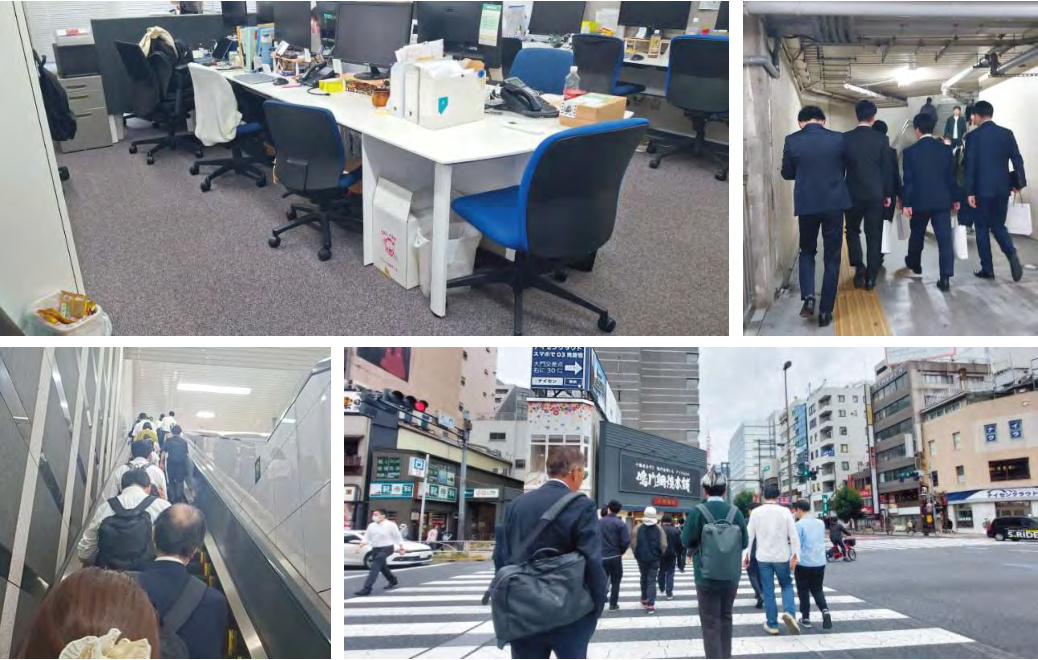
Read the English first, then the Japanese. The observations are the writer’s own, as published in Hiragana Times.
Before working in Japan, I had already heard the stories: arrive early, respect hierarchy, follow countless unwritten rules.
日本で働き始める前から、話は聞いていた。早めに出勤する、上下関係を大切にする、数えきれないほどの暗黙のルールがある――。
Nihon de hatarakihajimeru mae kara, hanashi wa kiite ita. Hayame ni shukkin suru, jōge kankei o taisetsu ni suru, kazoekirenai hodo no anmoku no rūru ga aru.
But knowing about a culture and actually living inside it are two completely different things.
でも、文化について知ることと、その中に実際に身を置くことはまったく別の話だ。
Demo, bunka ni tsuite shiru koto to, sono naka ni jissai ni mi o oku koto wa mattaku betsu no hanashi da.
Being “on time” often means arriving fifteen to thirty minutes before work officially begins.
たとえば「時間通り」とは、始業の15分から30分前に到着することを意味することが多い。
Tatoeba “jikan dōri” to wa, shigyō no jūgo-fun kara sanjuppun mae ni tōchaku suru koto o imi suru koto ga ōi.
Nobody tells you this directly — but when everyone around you follows the same pattern, the expectation is felt immediately.
誰も直接そう教えてくれるわけではないが、周りの全員が同じように動いていれば、その空気はすぐに伝わってくる。
Dare mo chokusetsu sō oshiete kureru wake de wa nai ga, mawari no zen’in ga onaji yō ni ugoite ireba, sono kūki wa sugu ni tsutawatte kuru.
Mornings start with a clear “Ohayō gozaimasu!” Leaving before others calls for “Osaki ni shitsurei shimasu,” and colleagues reply, “Otsukaresama desu.”
朝は「おはようございます!」で始まり、先に退勤するときは「お先に失礼します」と一言。すると「お疲れ様です」と返ってくる。
Asa wa “Ohayō gozaimasu!” de hajimari, saki ni taikin suru toki wa “Osaki ni shitsurei shimasu” to hitokoto. Suru to “Otsukaresama desu” to kaette kuru.
These small phrases quickly start to feel like part of who you are.
こういった小さなフレーズが、気づけば自分の言葉になっていく。
Kō itta chiisana furēzu ga, kizukeba jibun no kotoba ni natte iku.
Afterwards, it is surprisingly common to see colleagues quietly brushing their teeth in the office bathroom.
そして昼食後、オフィスのトイレで同僚たちが静かに歯を磨いている光景に出くわす。
Soshite chūshokugo, ofisu no toire de dōryōtachi ga shizuka ni ha o migaite iru kōkei ni dekuwasu.
It is a small everyday habit that initially surprised me, simply because it is not something you would commonly see in European workplaces.
それは小さな日常の習慣だが、ヨーロッパの職場ではあまり見かけないというだけの理由で、最初は驚いた。
Sore wa chiisana nichijō no shūkan da ga, Yōroppa no shokuba de wa amari mikakenai to iu dake no riyū de, saisho wa odoroita.
The written rules tell you how to do your job. The unwritten ones show you how a Japanese workplace actually feels.
書かれたルールは「仕事の仕方」を教えてくれる。書かれていないルールこそが、日本のオフィスの「空気」を教えてくれる。
Kakareta rūru wa “shigoto no shikata” o oshiete kureru. Kakarete inai rūru koso ga, Nihon no ofisu no “kūki” o oshiete kureru.
Read-aloud task: When you reach お先に失礼します and お疲れ様です, say them as if you were really leaving the office.
Your Voice | Leave the office with osaki ni shitsurei shimasu
Question: What unwritten rules are there where you work or study?
あなたの職場には、どんな暗黙のルールがありますか。
Anata no shokuba ni wa, donna anmoku no rūru ga arimasu ka.
- Take your leave: お先に失礼します。 (Osaki ni shitsurei shimasu.)
- Give the reply your colleagues would say: お疲れ様です。 (Otsukaresama desu.)
- Add one unwritten rule from your own workplace or school: [rule]のが暗黙のルールです。 (… no ga anmoku no rūru desu.) Say it first while reading, then without looking.
お先に失礼します。
Osaki ni shitsurei shimasu.
I’m heading out.
お疲れ様です。
Otsukaresama desu.
Don’t work too hard! Take care!
会議の5分前に来るのが暗黙のルールです。
Kaigi no go-fun mae ni kuru no ga anmoku no rūru desu.
Arriving five minutes before a meeting is an unwritten rule.
Reflect: Can you say お先に失礼します in 11 even beats, with a crisp つ (tsu) — and answer it right away with お疲れ様です?
Write your answer in the comments below — a We coach will reply.
Speak Your Language | Make お先に失礼します yours
Practice is not the goal. The goal is to make お先に失礼します your own word — and say what you really feel, in Japanese.
A new language gives you a new way to see the world, and a new self. Hiragana Times brings you real Japan every month, with English and Japanese side by side.
Speak Your Language.
Read the full article in Hiragana Times →
Learn Japanese through real Japan with We Languages — free consultation →