
TODAY’S WORD
まさか
masaka
3 beats: ma-sa-ka
まさか! masaka! = No way! + まさか、本当に! = No way, really?!
“No way!” — when the unexpected happens
At lunch, you joke: “Let’s all go to Hawaii for the office trip.” A month later, the plan is real.
What do you say? まさか! (masaka!) — “No way!” It is the word for the moment something you never expected actually happens.
Say what you never expected with まさか.
Read & Say | まさか
まさか has 3 beats. In Japanese, each beat takes the same length of time.
- All three vowels are a short, clear “a,” as in “father.”
- Said alone, まさか! sounds surprised. Let your voice show it.
Has a joke of yours ever come true?
Think first: Have you ever said something as a joke, and then it really happened?
Three ways to use まさか
1. On its own — “No way!”
まさか!
Masaka!
No way! / You’re kidding!
2. With what really happened. 〜とは (to wa) here means “that …,” and the sentence is left open, full of surprise.
まさか、本当になるとは。
Masaka, hontō ni naru to wa.
I never thought it would really happen.
3. With 冗談 — it was supposed to be a joke.
まさか!冗談のつもりだったのに。
Masaka! Jōdan no tsumori datta noni.
No way! It was supposed to be a joke.
| Word | Meaning |
|---|---|
| 冗談 jōdan | a joke |
| 本当 hontō | true, real |
まさか in a conversation
Aハワイ旅行、本当に決まったよ!
Hawai ryokō, hontō ni kimatta yo!
The Hawaii trip is really happening!
Bまさか!冗談だったのに。
Masaka! Jōdan datta noni.
No way! It was just a joke.
A言ってみるものだね。
Itte miru mono da ne.
It pays to say things out loud.
Quiz | まさか
Q1. How many beats are in まさか?
Answer
b) 3 — ま・さ・か.
Q2. Your friend tells you your joke plan has really come true. What do you say?
Answer
a) まさか! (Masaka!) — “No way!”
Q3. What does 冗談 mean?
Answer
A joke (jōdan).
The old way to say it: a horse from a gourd
FROM HIRAGANA TIMES
When a joke comes true, Japanese also has a colorful old proverb: 瓢箪から駒 (hyōtan kara koma), “a horse from a gourd.” The November 2026 issue of Hiragana Times, a bilingual magazine published in Japan since 1986, tells its story in the “Nihongo Do — Voice-Word Art” page.
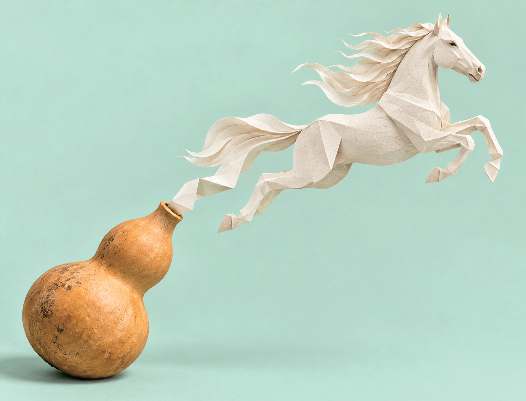
冗談が、本当になる。
Jōdan ga, hontō ni naru.
A joke comes true.
日本人は、その不思議を「瓢箪から駒」と呼んできました。
Nihonjin wa, sono fushigi o “hyōtan kara koma” to yonde kimashita.
The Japanese have called this wonder “a horse from a gourd” (hyotan kara koma).
「駒」は将棋の駒ではなく、馬のこと。
“Koma” wa shōgi no koma de wa naku, uma no koto.
“Koma” is not a shogi piece, but a horse.
もとは中国の仙人・張果老の話。
Moto wa Chūgoku no sennin, Chō Karō no hanashi.
It comes from a tale of Zhang Guolao, a Chinese immortal.
白いロバで旅をし、使わない時は紙のようにたたんで瓢箪にしまい、乗る時は水を吹きかけて戻しました。
Shiroi roba de tabi o shi, tsukawanai toki wa kami no yō ni tatande hyōtan ni shimai, noru toki wa mizu o fukikakete modoshimashita.
Traveling on a white donkey, he folded it like paper into a gourd when not in use, and sprayed it with water to bring it back.
| Everyday | Proverb |
|---|---|
| まさか! masaka! — No way! | 瓢箪から駒だね。 hyōtan kara koma da ne — a horse from a gourd! |
Your Voice | What did you never expect?
まさか、〜とは!
Masaka, … to wa!
I never thought …!
- Think of something you never expected to happen.
- Put it between まさか、 and とは!
- Read it aloud, then say it without looking.
まさか、本当に日本に住むとは!
Masaka, hontō ni Nihon ni sumu to wa!
I never thought I would really live in Japan!
Write your answer in the comments below — a We coach will reply.
Speak Your Language | Make まさか yours
Practice is not the goal. The goal is to make まさか your own word — and say what you really feel, in Japanese.
A new language gives you a new way to see the world, and a new self. Other lessons stop at “masaka = no way.” We teach the moment a joke comes true. That’s We.
Speak Your Language.
Read the full article in Hiragana Times →
Learn Japanese through real Japan with We Languages — free consultation →