

TODAY’S WORD
割る・割れる
waru · wareru
2 beats + 3 beats: wa-ru / wa-re-ru
を割る o waru = you split it ⇄ が割れる ga wareru = it splits
“to split (something)” — and “to split open”
A summer beach. Your friend is blindfolded, holding a stick over a watermelon. Everyone shouts “Left! Right! Now!” — the stick comes down, there is a crack, and the whole group yells: “割れた!” (Wareta! — It split open!)
Your friend pulls off the blindfold and says something slightly different: “わたしが割った!” (Watashi ga watta! — I split it!) Same watermelon, two verbs: 割る (waru, someone splits it) and 割れる (wareru, it splits).
Say what you split — and what simply broke — with 割る and 割れる.
Read & Say | 割る・割れる
The kanji 割 is read wa in both words. 割る has 2 beats; 割れる has 3 beats. In Japanese, each beat takes the same length of time.
割る (waru)
割れる (wareru)
- The only difference is one beat: れ (re). Listen for it — it tells you whether someone did it or it just happened.
- る・れ (ru, re): the Japanese “r” is a light tap of the tongue — close to the “tt” in American “better.”
- Keep the beats even, with no strong stress.
Did you break it, or did it break?
Think first: Think of the last thing that cracked or broke near you — an egg, a glass, a phone screen. Did you do it? Or did it just happen? How would you say it in your own language?
How 割る and 割れる work
Japanese has many verb pairs like this: one verb for “someone does it to a thing,” and a different verb for “the thing does it by itself.” 割る and 割れる are one of the most useful pairs.
⇄
スイカが割れるsuika ga wareru — the watermelon splits
Watch the particle. With 割る, the thing takes を (o). With 割れる, the thing becomes the subject and takes が (ga).
[person]が [thing]を 割る
[person] ga [thing] o waru
[person] splits / cracks / breaks [thing]
[thing]が 割れる
[thing] ga wareru
[thing] splits / cracks / breaks
卵を割る。
Tamago o waru.
I crack an egg.
皿が割れた。
Sara ga wareta.
The plate broke.
わたしがスイカを割った!
Watashi ga suika o watta!
I split the watermelon!
| Form | 割る (someone does it) | 割れる (it happens) |
|---|---|---|
| dictionary | 割る waru |
割れる wareru |
| polite | 割ります warimasu |
割れます waremasu |
| past | 割った watta |
割れた wareta |
A real-life note: when a plate slips out of their hands, many Japanese speakers say 皿が割れちゃった (sara ga warechatta, “the plate broke — oops”) rather than “I broke the plate.” Some say this keeps the focus on what happened instead of on blame; others simply hear it as the natural way to report an accident. But if someone asks 誰が割ったの? (Dare ga watta no? — Who broke it?), the honest answer switches to 割る: わたしが割りました。 (Watashi ga warimashita. — I broke it.)
Everyday 割る・割れる
| Word | Meaning |
|---|---|
| 卵を割る tamago o waru |
to crack an egg |
| 皿が割れる sara ga wareru |
a plate breaks |
| スイカ割り suikawari |
watermelon splitting — a summer game: blindfolded, you try to split a watermelon with a stick while friends call out directions |
| 割り勘 warikan |
splitting the bill equally |
割る・割れる in a conversation
Two friends playing スイカ割り on the beach. A gives directions; B has the stick.
Aもうちょっと右!
Mō chotto migi!
A little more to the right!
Bここ? えいっ!
Koko? Ei!
Here? Hyah!
A割れた!
Wareta!
It split open!
Bやった! わたしが割った!
Yatta! Watashi ga watta!
Yes! I split it!
A reports what happened to the watermelon (割れた). B claims the credit (わたしが割った).
Quiz | 割る・割れる
Q1. How many beats are in 割れる?
Answer
b) 3 — わ・れ・る.
Q2. “I crack an egg.” Which particle goes in the gap?
卵( )割る。
Answer
a) を — with 割る, the thing you split takes を.
Q3. “The plate broke.” Which verb?
皿が( )。
Answer
b) 割れた — the plate is the subject (が), and it broke by itself.
Q4. What does 割り勘にしよう (warikan ni shiyō) mean at a restaurant?
Answer
“Let’s split the bill.” Here 割る means to divide — not a watermelon, but the money.
割れたのは、スイカ — today’s word on a cover
FROM HIRAGANA TIMES
Today’s lesson starts from a magazine cover. The December 2026 issue of Hiragana Times, a bilingual magazine published in Japan since 1986, opens with a cover story titled 割れたのは、スイカ (Wareta no wa, suika) — “What Split Open Was a Watermelon.” The painting is by Bunta Inoue, the artist mad about painting (gakyōjin).
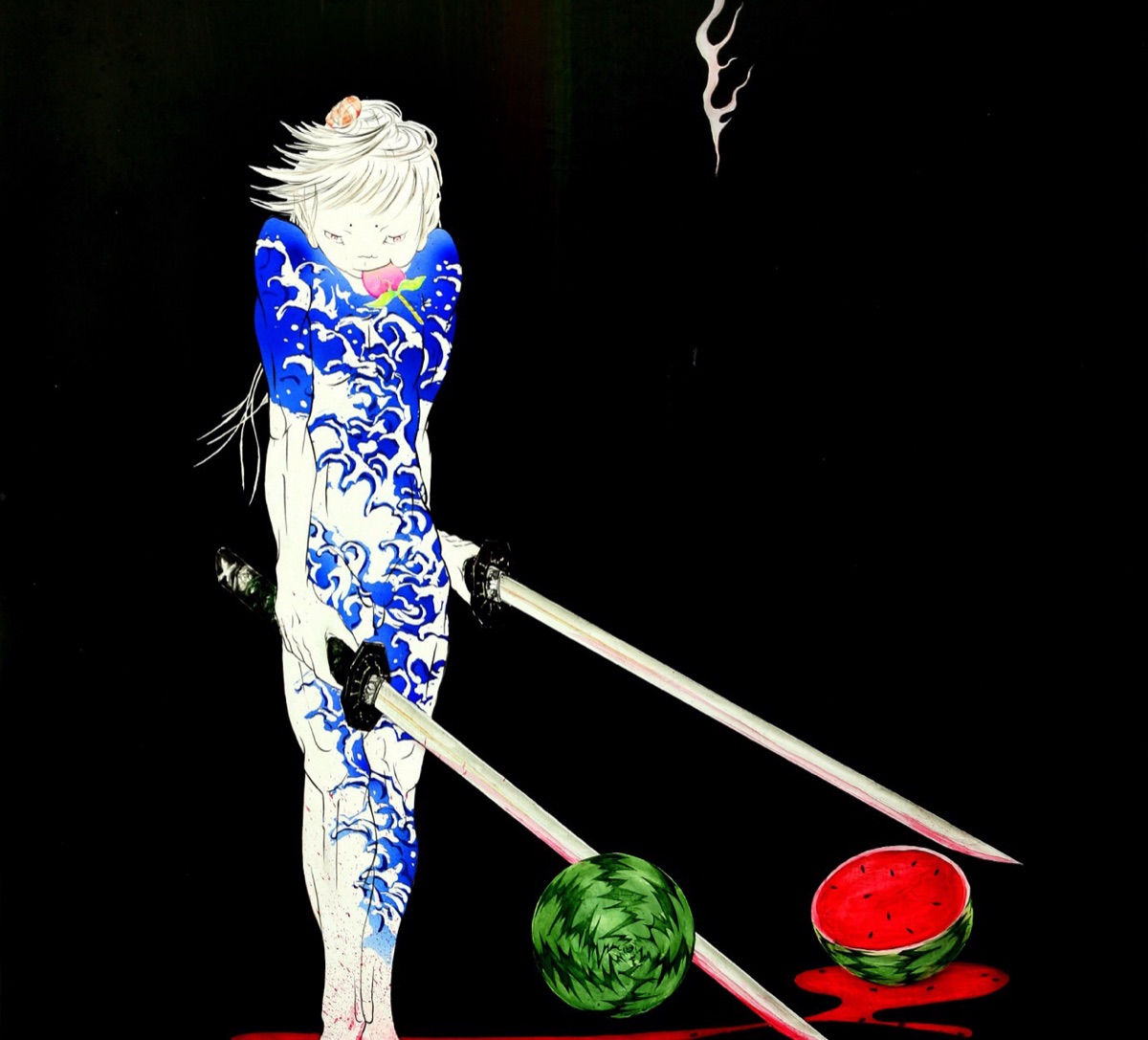
On the cover of the December issue, of all things, a watermelon.
12月号の表紙に、まさかのスイカ。
Jūni-gatsu-gō no hyōshi ni, masaka no suika.
This is “Watermelon Splitting, Dyed Crimson on a Summer Night” (Earth Genesis: Yokai Suikoden) by Bunta Inoue, the artist mad about painting (gakyōjin). Red drops fall from two swords, and the ground below is crimson. For a moment it is startling, but what was cut is a watermelon. Memories of the sword and of the kitchen knife overlap in a single picture.
画狂人 井上文太氏の『夏之夜二 深紅二染マル 西瓜割リ』(地球創世記 妖怪水滸伝)です。2本の刀から赤いしずくが落ち、足元は深紅。一瞬ぎょっとしますが、斬られたのはスイカ。刀と台所の包丁の記憶が、1枚に重なります。
Gakyōjin Inoue Bunta-shi no “Natsu no yo ni shinku ni somaru suikawari” (Chikyū Sōseiki Yōkai Suikoden) desu. Ni-hon no katana kara akai shizuku ga ochi, ashimoto wa shinku. Isshun gyotto shimasu ga, kirareta no wa suika. Katana to daidokoro no hōchō no kioku ga, ichi-mai ni kasanarimasu.
Look at the verbs. The article says 斬られた (kirareta, “was cut” — by a sword). The title says 割れた (wareta, “split open”). Seen from the sword, it was cut; seen from the watermelon, it split open. And the painting’s title ends with 西瓜割リ — suikawari, written in an old style, with 西瓜 as the kanji for スイカ.
Your Voice | What did you split — and what broke?
[thing]を割りました。 [thing]が割れました。
[thing] o warimashita. [thing] ga waremashita.
I split / cracked [thing]. [thing] broke.
- Think of one thing you split or cracked on purpose, and one thing that broke.
- Put them into the patterns above — を with 割る, が with 割れる.
- Read it aloud, then say it without looking.
子どものころ、海でスイカを割りました。先週、お気に入りのカップが割れました。
Kodomo no koro, umi de suika o warimashita. Senshū, okiniiri no kappu ga waremashita.
When I was a child, I split a watermelon at the beach. Last week, my favourite cup broke.
Write your answer in the comments below — a We coach will reply.
Speak Your Language | Make 割る・割れる yours
Practice is not the goal. The goal is to make 割る・割れる your own words — and say what you really feel, in Japanese.
A new language gives you a new way to see the world, and a new self. Other lessons stop at a list of “transitive and intransitive verb pairs.” We start from the moment something splits — did you do it, or did it just happen? — and teach you to say it the way you mean it, from the proud わたしが割った! to the honest わたしが割りました. That’s We.
Speak Your Language.
Read the full article in Hiragana Times →
Learn Japanese through real Japan with We Languages — book your free counseling →